
Metadata And Data Brokering Online Tool
Publish your research data FAIR.
Madbot connects the places your data already lives (a cluster, Galaxy, S3, OMERO) to the repositories that publish it. Describe it once, with help to keep to standard metadata, check it against the requirements of the repository you choose (today ENA, Recherche Data Gouv and Zenodo), and submit it in one click. Or simply keep your project’s metadata in madbot as it comes, share it with your collaborators and core facilities, and be ready to submit when the time comes.
Animated example in four steps. 1: you tell madbot where your data is stored, and nothing is copied. 2: you describe it with metadata fields that are checked as you type. 3: madbot translates each field into the format of the repository you chose. 4: madbot fetches the files, checks them and submits them, and the repository returns an identifier. Four use cases: sequencing reads from a cluster to ENA, microscopy images from S3 to Recherche Data Gouv, RNA-seq counts from Galaxy to Zenodo, and an ongoing soil survey with no submission yet, whose metadata stays in madbot, shared with the team and ready when you are.
madbot todayas of 19 novembre 2026
How it works
Four steps from lab bench to repository
Research data goes through a life cycle, from planning to reuse. Madbot joins it as soon as you collect your data: it links the data you collect, process and analyse where it is stored, helps you describe it as you go, and publishes it to a repository where it is preserved and shared, ready to be reused.
Without it, describing and publishing data usually waits until the end of a project, and is done from memory. With madbot, it takes four steps: open your workspace, link your data, describe it, publish it. Save time: you never enter the same information twice.
01
Open a workspace for your project
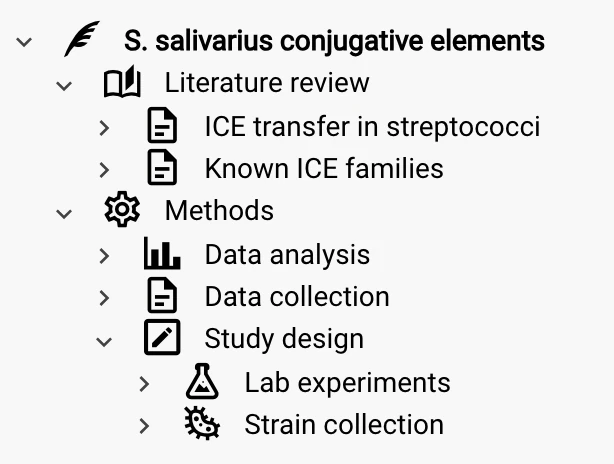
Your project lives in your team’s workspace, a shared space where the colleagues you invite can read and complete its information. Shape it like a directory tree, in a way that makes sense to you: name each level and nest it as deep as you need, following the ISA model, your field’s conventions or simply your lab’s habits. Each level holds its own description, samples, datalinks and metadata.
02
Link data where it already lives
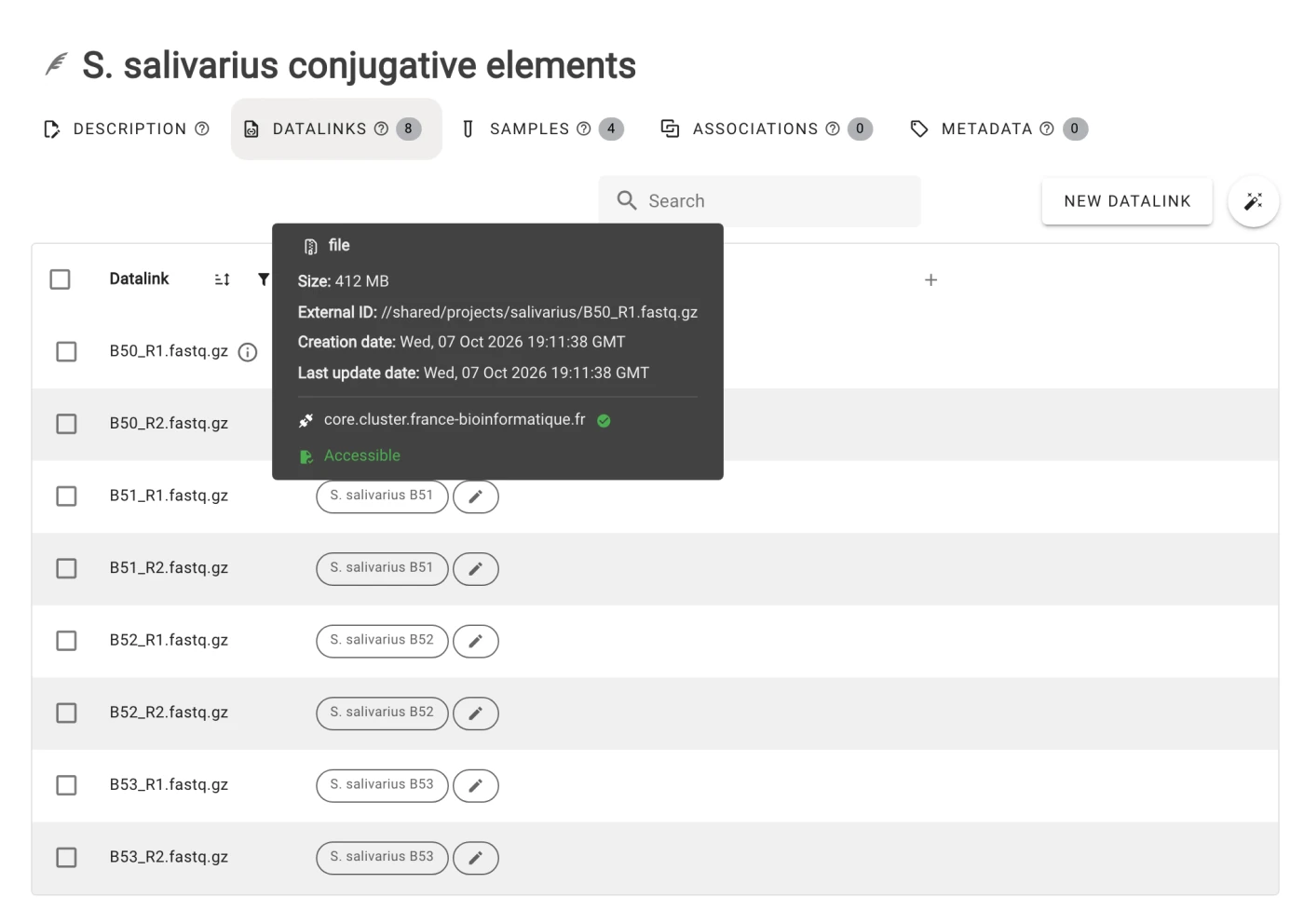
Link madbot to your files, whether they are stored on a computing cluster, a NAS storage system, Galaxy, OMERO or an S3 bucket. Madbot doesn’t store your files: it creates “datalinks” to where each dataset is stored, and checks that it is still accessible.
03
Describe once, inherit everywhere
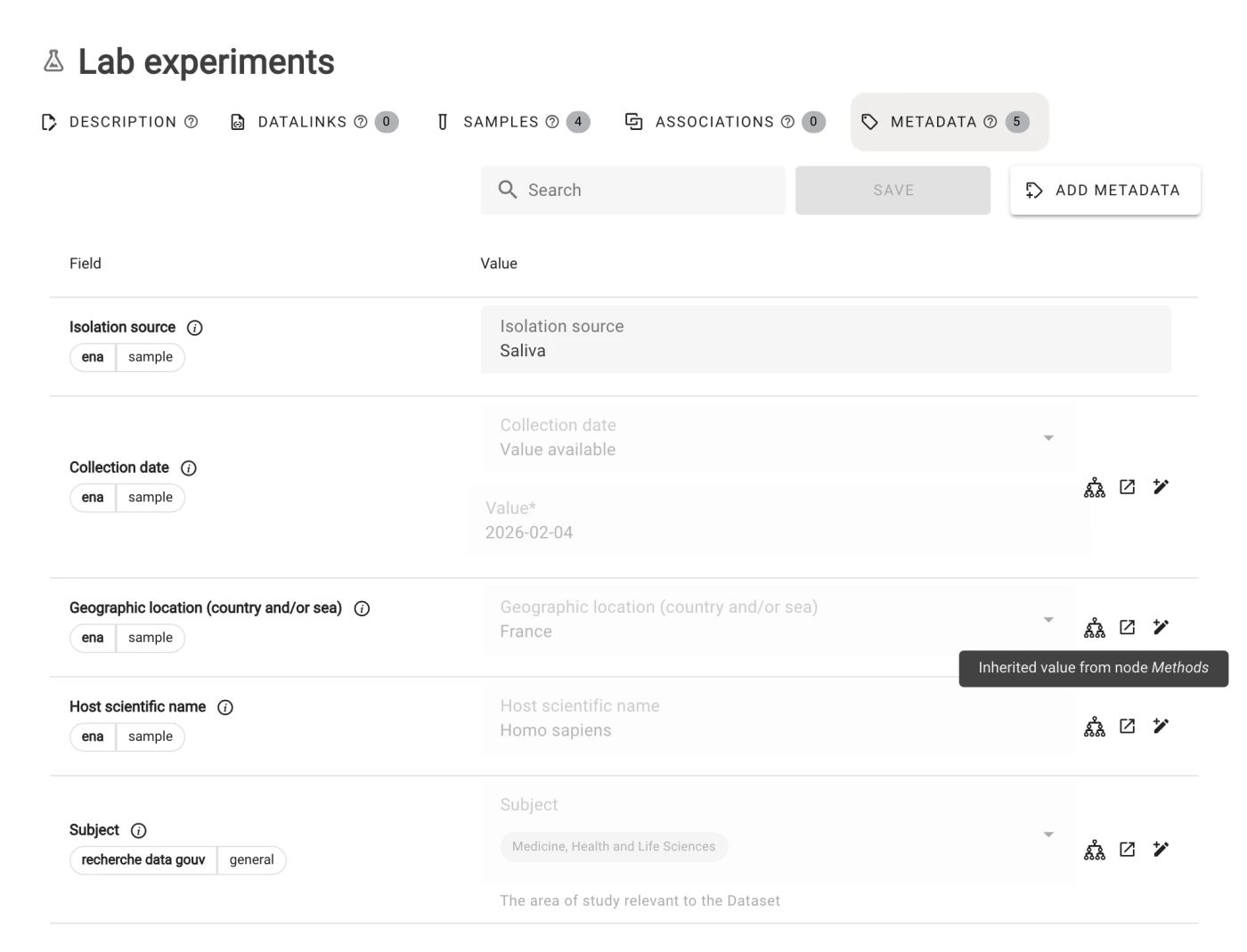
Describe your data with fields from community standards such as Dublin Core, Darwin Core or ENA checklists, or from madbot’s own referential. Every value is checked against the referential as you type, and mapped to the repositories’ formats. Save time: a value set on a parent level flows down to its children, so you don’t type it again for each of your datasets, and you can still override it.
04
Publish in one click
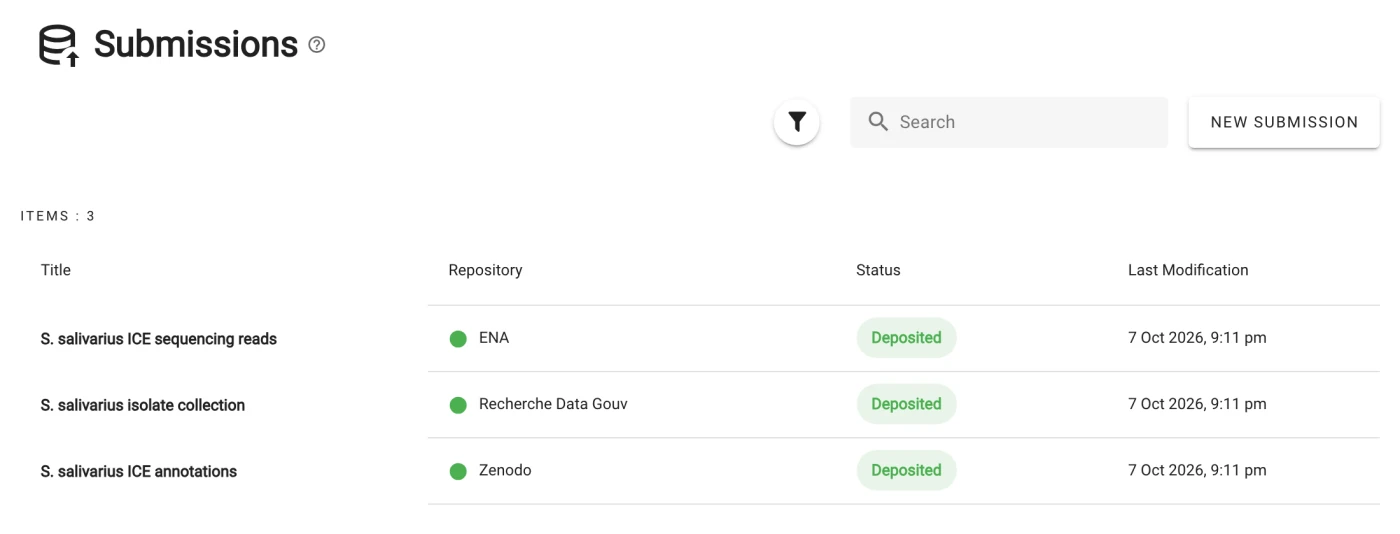
Choose the datalinks to publish and the repository. Madbot fetches the files, maps your metadata to the repository’s format, validates it and submits it. The DOI or accession number comes back into madbot, linked to your data.
Across disciplines
Not just genomics
Madbot was born in bioinformatics, but its workflow isn’t tied to DNA. Plugins bring each field its own storage, standards and repositories.
Each use case below works with today’s plugins.
Genomics
Sequencing runs
Paired-end reads described with ENA checklists and submitted as samples and runs.
 SSHFS
Described with
ENA checklists
 Madbot assembles data and metadata into an ENA submission.
Published to
 ENA
Bioimaging
Microscopy screens
Images stay in OMERO; madbot describes the experiment and publishes it.
 OMERO
Described with
Dublin Core
Madbot translates Dublin Core to Recherche Data Gouv’s format, then assembles the deposit.
Published to
 Recherche Data Gouv
Omics analyses
Workflow outputs
Results from a Galaxy history, described once and published with a DOI.
 Galaxy
Described with
madbot referential
Madbot translates its own fields to Zenodo’s format, then assembles the deposit.
Published to
 Zenodo
Biodiversity
Occurrence data
Species observations described with Darwin Core terms, the standard of biodiversity data.
 S3
Described with
Darwin Core
Madbot translates Darwin Core to Zenodo’s format, then assembles the deposit.
Published to
Zenodo
Research software
Code and notebooks
A release from your repository, archived with its authors and license.
 GitLab
Described with
Dublin Core
Madbot translates Dublin Core to Zenodo’s format, then assembles the deposit.
Published to
Zenodo
Your field
Build it with your community
Occurrence data bound for GBIF? Microscopy images for the BioImage Archive? Each new use case is a plugin, and the next ones are best built with the people who need them.
Plugins
Plugs into what you already use
Every connection is a small Python plugin. There are three kinds, and you can contribute by writing a community plugin for your needs.
Connect data from
Storage types you can create datalinks on.
 Preview
 Community
Describe with
Field sets that extend the metadata catalogue.

 Preview
 Still evolving: it works, and your feedback helps us stabilize it.Community Built and maintained by partners outside the core development team.
Browse all plugins on GitLab ↗ How to write a community plugin ↗ Discover our contributors →
Workspaces
As open as possible, as closed as necessary
Each team gets its own workspace. Invite people such as your collaborators or the core facilities that produce your data, give them a role on each level, and keep restricted what must not be disclosed while the rest stays visible to collaborators.
For developers and institutions
Built to fit your infrastructure
Madbot is open source and designed to work with your own tools, not only through its interface.
API
A documented REST API
An OpenAPI 3 API, documented with Swagger, lets scripts and lab information systems (LIMS) work with madbot directly.
Plugins
Extend it in Python
The plugin API and its development guide let you add a connection without touching madbot’s core. Partners already maintain their own.
Security
Credentials in a vault
The credentials madbot uses to reach your storage are kept in HashiCorp Vault.
Quality
Checked on every change
Each change to madbot’s code goes through automated style and quality checks, dependency and security scans, and tests before it is released.
License
Open source, BSD-3-Clause
The code is public on GitLab. Read it, reuse it, deploy it or contribute to it.
Archive
Preserved on Software Heritage
Madbot’s source code is archived by Software Heritage, the universal archive of software source code.
Developer documentation ↗ Source code on GitLab ↗ Software Heritage ↗
Roadmap 2026
What’s next for madbot
Q1
- Import metadata when creating a datalink
- Batch metadata editing
- Duplicate and move levels
- Personal access tokens for the API
Q2
- SSH key authentication for SSHFS
- Recherche Data Gouv submission plugin
- Accession numbers and DOIs shown on submissions, data and metadata
- Suggested metadata values and sample–data associations
- Easier sample–data associations, with guidance for paired data
Q3
- Faster lists, project trees and metadata pages
- Plugin maturity shown in the app (Stable or Preview)
- A profile with ORCID and ROR identifiers
- Smoother editing: visible multi-selection, accurate unsaved-changes warnings, fixed rich-text editors
- Clear error messages when a plugin connection fails
Q4
- Batch editing everywhere, in one fast table view
- A faster application start-up
- Metadata entry: autosave, clearer validation, a single window to add fields
- Create datalinks and samples in bulk, with clear errors when something fails
- Typed data associations (paired, assembly…)
- A clearer interface: guided discovery of madbot’s vocabulary, separate user and workspace settings
- A documented API path for data-producing platforms
Want the details? Follow the epics on Taiga ↗
Team
Meet the people behind madbot
Developers and project leads at the Institut Français de Bioinformatique (IFB/ELIXIR-FR), in Paris and Strasbourg, working to fit FAIR research data into researchers’ busy schedules.

Thomas Denecker
Project owner
Research Engineer, CNRS
IFB-core, Hub Pasteur · Paris
“This is awesome! Let’s try it!”

Julien Seiler
Project owner
Research Engineer, CNRS
IFB-core, BigEst · Strasbourg
“It’s great but…”

Baptiste Rousseau
Full-stack developer
Research Engineer, CNRS
IFB-core, Hub Pasteur · Paris
“I may have gone down a rabbit hole… but look what I found!”

Elora Vigo
Full-stack developer
Research Engineer, CNRS
IFB-core, BigEst · Strasbourg
“Isn’t this a bit off-center?”
National working group
Shaped with institutes across France
Researchers, data-producing platforms and national infrastructures meet in madbot’s working group. Its members try madbot on their own use cases, tell us what to fix, and take it back to their communities.












Link your first dataset in minutes.
Madbot is free and open source, and runs on French public research infrastructure.
One email a month. Unsubscribe anytime.