
On May 5, madbot was presented at two curathons of the Printemps de la donnée, on the same day:
- in Poitiers, by Thomas Denecker (curathon page);
- in Nantes, by Imane Messak and Baptiste Rousseau (slides on HAL).
On May 5, madbot was presented at two curathons of the Printemps de la donnée, on the same day:
On April 20, madbot took part in the Printemps de la donnée in Clermont-Ferrand.
After a presentation of the tool, the team ran a hands-on workshop built on a dedicated training set.
👉 The training set used in the workshop is openly available on Zenodo, so you can replay it on your own.
Madbot now has its own page on Cat OPIDoR, the French catalogue of services for research data.
Research teams, data stewards and support staff looking for a tool to organise, describe and submit their data can now find madbot there, alongside the other services of the research data landscape.
Madbot 1.4.0 is now available. Here is what is new 👇
A new panel draws charts from the metadata of your samples and datalinks.
The batch edit table now supports the clipboard, to move values around as you would in a spreadsheet.
Select several samples, datalinks, submission data or node metadata and delete them in one go.
The submission page shows more information, guides you through paired data, and tabs now display how many objects they hold.
A new API endpoint handles metadata in batches, and a plugin can now declare several shared parameters.
And as always, security updates and fixes behind the scenes. Full release notes are on GitLab.
On April 1, the madbot team was invited to a seminar at Institut Pasteur, attended by about fifty people.
Thomas Denecker and Julien Seiler, who co-lead the project, opened the session. Imane Messak and Baptiste Rousseau then ran the demonstration, playing two researchers who face everyday data management problems and solve them with madbot.
Since madbot opened in December 2025, the instance had gathered:
The seminar ended with a discussion on where madbot goes next, and on shared goals for future collaborations.
👉 The slides are on HAL. Read also the IFB article (in French).
Madbot 1.3.0 is now available. Here is what is new 👇
Samples, datalinks and the metadata objects of a submission now open in a spreadsheet-like table: one row per object, one column per metadata field. In this table you can:
Create, list and revoke tokens from Parameters → Tokens, and use them to call the API from your scripts or pipelines.
Sibling nodes can now be reordered, so the workspace tree shows them in the order that makes sense to your project.
Nodes created through the API can carry a description written in Markdown; madbot converts it for the editor.
New fields map to ENA checklists 23 and 25: environmental context, geographic location, nucleic acid, PCR conditions and primers, library and sequencing details, multiplex identifiers.
Full release notes are on GitLab.
Deployed on February 17, madbot 1.2.0 is now available! Many new features are ready to be discovered and explored, including 👇
You can now move or duplicate a node along with its entire structure (metadata, samples, data links, and children) in just a few clicks.
Metadata fields are now organized into hierarchical groups for improved readability. For better usability, you can also sort and filter fields directly within the add-field modal — alphabetically or by requirement level.
Import your sample lists via drag-and-drop or copy-paste, with a preview before confirmation. A significant time saver for teams managing large volumes of samples.
Users can now manage their notification preferences: receive alerts when joining a workspace or track the progress of a submission. No more missing key steps.
The plugin engine has been thoroughly redesigned for greater independence and robustness.
And as always, dozens of improvements and fixes behind the scenes: enhanced security (PKCE, OAuth2), improved performance, and a refined user experience across the platform. Madbot keeps evolving with you. 💪
👉 Questions about these updates? We’re available to discuss them on Tchap.
You can also find full release details on GitLab.
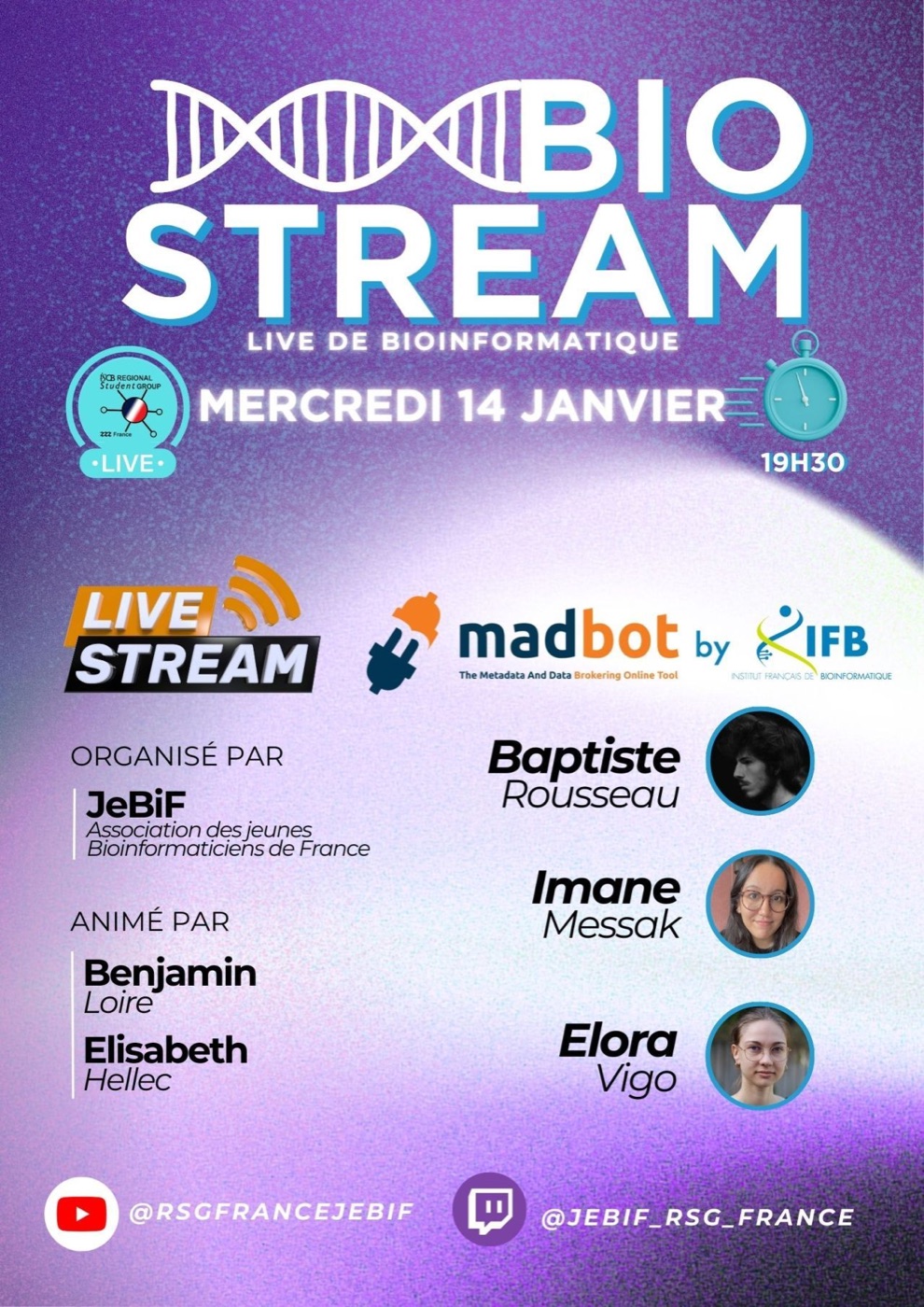
On January 14, Imane Messak, Baptiste Rousseau, and Elora Vigo were guests on JeBif to present madbot in the first BioStream of the year. BioStream is the monthly live show on YouTube and Twitch by the Association of Young Bioinformaticians of France (JeBif)!
Didn’t see it? Watch the replay on YouTube!
Prefer audio? Listen to the podcast version
We are thrilled to announce that the madbot instance is now live!
From today, our community can start exploring, testing, and using madbot to manage and share scientific data more efficiently.
We believe madbot can make metadata management easier and more collaborative. Opening an instance to the community is our way of making the project more transparent and participatory.
In the coming weeks, we will:
👉 Feel free to join us, explore, and share your thoughts. This is just the beginning 🚀